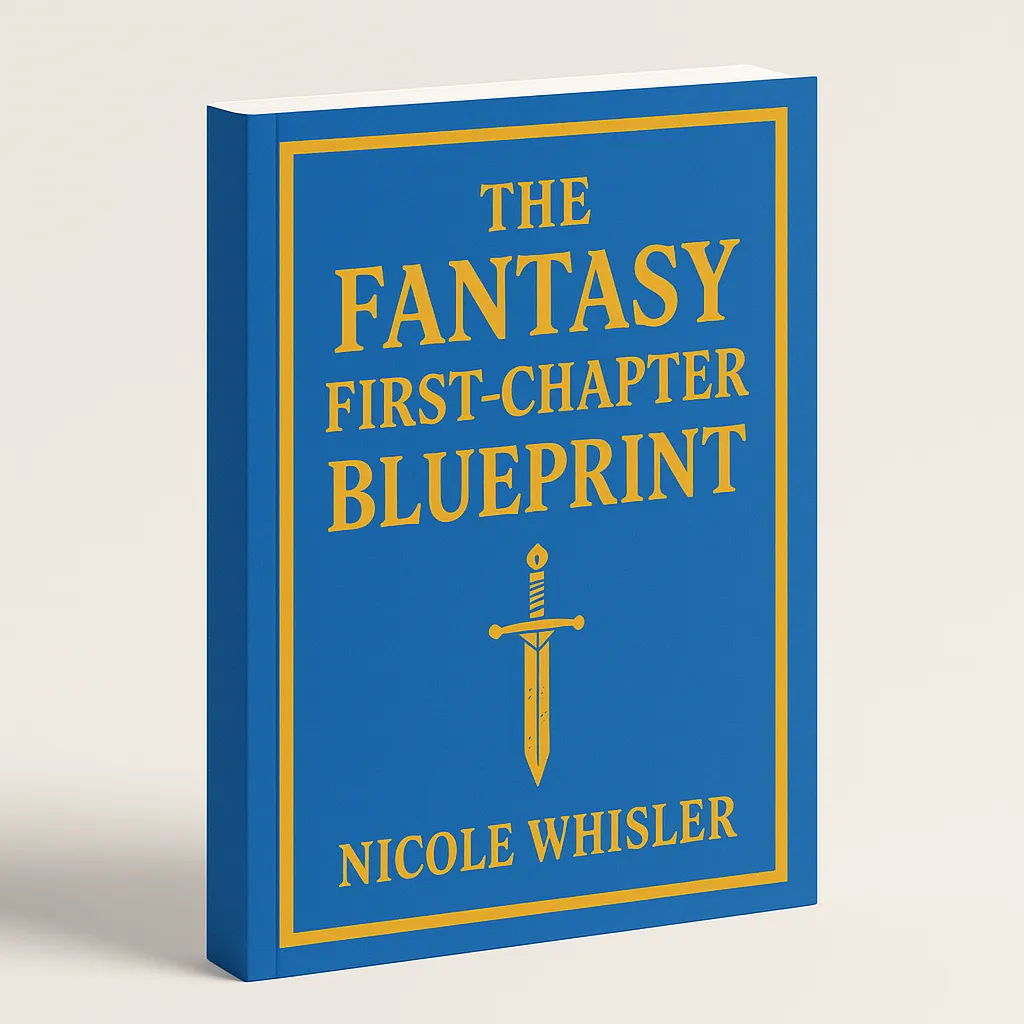
The Fantasy First-Chapter Blueprint
Your first chapter is your one shot to hook an agent or a reader. Don't let the 7 deadliest mistakes land your manuscript in the rejection pile. This free 7-day email course gives you the step-by-step blueprint to avoid them and craft an irresistible opening.

Your Novel Matters ...
Looking for the right book coach for your fantasy novel?
Are you a fantasy writer …
… struggling to convert the vivid scenes of your fantasy novel from your imagination to the page?
… stuck in a loop where you constantly rewrite your opening pages?
… worried your story won’t resonate with your readers?
What if I could show you the exact steps week to week that would take you from brainstorming and drafting to revising and publication?
I specialize in developmental editing and book coaching for writers of fantasy novels—writers who value the craft of storytelling and wish to create stories that resonate.
My Services
Develop Your Ideas
Fantasy Footsteps: Road to Publication
I’ll let you in on a secret. All you need to succeed as a writer are three things:
A Roadmap: Illuminate your path with a step-by-step guide, ensuring you achieve your writing goals every week. From outlining to publishing, every stage of your journey is mapped out for success.
Mindset Mastery: Learn how your thoughts control your outcomes in your writing. Overcome self-doubt and unearth the confidence that will bring your unique ideas to life on the page.
Personalized Support: Prepare for comprehensive assistance, real-time accountability, and feedback tailored to your needs. From brainstorming sessions to final publication, you'll have a dedicated ally guiding you every step of the way.
With these three pillars, you'll unlock the potential to:
Craft a captivating story that enthralls readers from the first page to the last.
Develop complex characters and immersive worlds that resonate deeply with your audience.
Navigate the complexities of plot twists and pacing, keeping readers hooked until the final chapter.
Receive specific guidance on refining your scenes so that readers root for your protagonist.
Overcome writer's block and stay motivated throughout your writing journey, ensuring consistent progress.
Transform your rough draft into a polished, professional manuscript ready for publication.
Are you ready to turn your fantasy novel from a mere vision into a masterpiece that captures hearts and minds?
Join Fantasy Footsteps: Road to Publication and begin your author journey with everything you need to write a story that works.
Don't let your story remain trapped in your mind—bring it to life with me!
If you’re thinking, “Yes, please! Tell me what to do!” , I’d like to invite you to work one-to-one with me to finish your novel and write a story that works. Join my book coaching program designed specifically for fantasy writers—Fantasy Footsteps: Road to Publication.

Discover Helpful Tools
Resources For Writers
Here you will find some of my favorite resources for writers.
Add these books, podcasts, websites, and other resources to your writing toolbox to augment your writing at any stage.
Join My Free, Private Facebook Group
Finish My Fantasy Novel: Write & Revise My Best Book in 6 Months
In the group, I go live weekly with writing tips. The group is also a platform for writers to support each other and share their wins and progress.
Live training schedule:
1st Tuesday of the month: Free critique for someone in the group!
2nd Tuesday of the month: Writing sprint with fellow writers
3rd Tuesday of the month: Live training on a specific topic
4th Tuesday of the month: Interview with an author or marketing/business expert


Improve Your Craft
Writing Advice Blog
As a developmental editor and book coach, everything I post is designed to help you build your creativity, strengthen your prose, and explore new avenues in your writing. The opinions in each post are my own, but many are inspired by ideas from established authors and editors who excel in their fields.
Rely on my blog for clear and specific writing advice, motivational tips and grammatical aid, and interviews with experts!
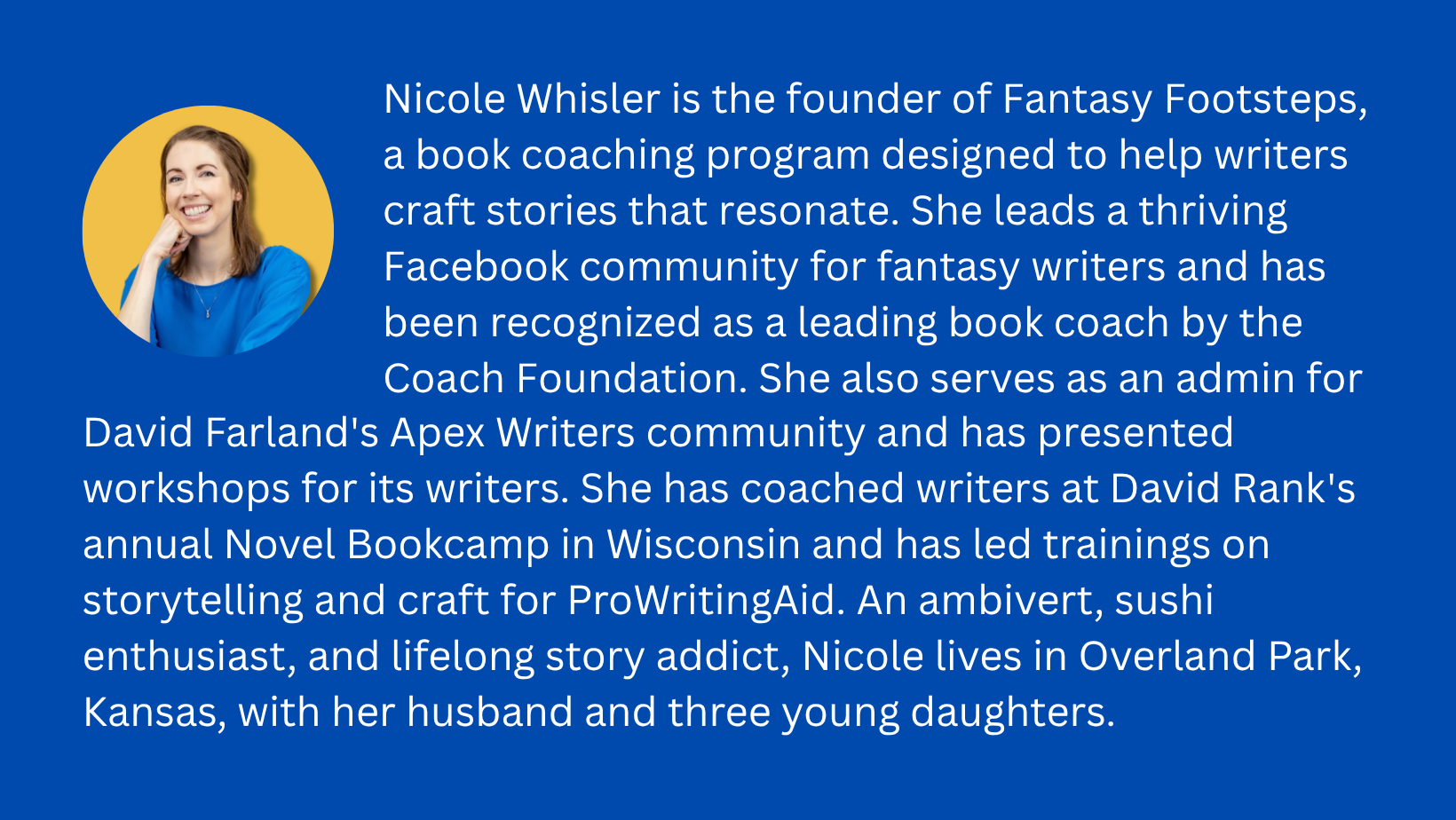
Hi! I'm Nicole.
I’m a Developmental
Editor & Book Coach for Fantasy Writers.
Like you, I'm a writer. I understand the mental and emotional ups and downs of storytelling. Don't let resistance win! Recognize the value of good advice plus hard work.
My approach to novel writing is multifaceted. For a deeper understanding of my process and style, take a look at some of my favorite craft-of-writing books in my Resources section.
What can I say about myself? I read, I write, I read about writing, and I write about reading. It never gets old to me.

See what writers like you are saying . . .

Nadir Shirazi
“I’ve been stalling on my Islam-inspired sci-fantasy series for 10 years. But within 10 minutes of starting Nicole’s program, I started writing again."
Amanda Emerick
“I can’t recommend Fantasy Footsteps enough to writers who are legitimately looking to polish their craft, write, and eventually publish their novel."
Trinity Cunningham
“I loved discussing my story with Nicole. She provided me with invaluable insights I never would have considered on my own."
Latest on the Blog

You will find no pictures of kittens here. No images of favorite dessert recipes, snapshots of my recent vacations, videos of puppies playing the piano (although I do love dogs), or YouTube clips of monkeys stealing people’s sunglasses.
I’m genuinely sorry if that disappoints you.
Instead, you can rely on my blog for clear and specific writing advice, motivational tips, grammatical aid, and author/editor interviews.
As a developmental editor & book coach, everything I post is designed to help you build your creativity, strengthen your prose, and explore new avenues in your writing. The opinions in each post are my own, but many are inspired by ideas from established authors and editors who excel in their fields.
Some of these tips might be just what you need to hear. Others might not work for you personally, and that’s okay.
Apply the tips that fit your personality and writing habits, and feel free to adapt or ignore the others. For further questions and comments, you can email me or reach me through my Contact page.

On Failure
Discover in this post …
why failure is an essential part of becoming a stronger writer.
practical ways to step outside your comfort zone and risk failure.
how to turn rejection and setbacks into fuel for your next step.
Fail Often & Fail Well
Can you recall where you first heard the saying, “It’s okay to make mistakes”? Was it a parent? A teacher? A mentor?
The idea makes sense in some situations. If you trip while carrying coffee and your mug smashes to bits on your kitchen floor … yes, something objectively negative happened (your mug broke), but it’s okay, you can clean it up. If you’re assigned a group project at school and you forget your part of the project at home the day of the presentation … again, that’s a negative scenario because you did, in fact, let your classmates down—but it’s okay because you can do your best to make it right.
Notice how in the examples above, “okay” implies that something has gone wrong. People use the word when they’re discussing a situation in which a person has a reason to feel sorry.
But in the writing world, if you’ve made mistakes and failed, I congratulate you. I say you’ve done something right. Not because mistakes themselves are the end goal, but because you were willing to take the kind of risk that propels you toward your goal and gives you the opportunity to learn.

On your writing journey, it’s not okay to make mistakes. It’s not okay to fail. It’s not something you need forgiveness for. Rather, it’s an essential and desirable part of the writing process.
If you’ve failed once as a writer, well done. If you’ve failed five times, I salute you. If you’ve failed 500 times, you are my hero. Why? Because you’ve done what most other writers haven’t. You’ve put yourself in repeated situations of discomfort, and (if you’ve made the most of them) you’ve learned from every mistake.
And the coolest part? The more failures you encounter—and study—the faster your path to success can become.
Let’s take a look at how this works.
Failure Is an Opportunity
The moment I stepped through the doors of the Jefferson City Library in 2017, climbed two flights of stairs, and attended my first writing critique group, I could literally feel the risk I was taking. My heart pounded erratically, and my mind crowded with all kinds of thoughts: Who am I going to meet today? Will the group like my writing? Is my story any good? Will they crush my dreams? WHAT’S GOING TO HAPPEN?

I was excited and terrified at the same time. Despite my fears, I had chosen to take a step totally outside my comfort zone. No one else had seen the novel I was working on—my fourth. I didn’t know whether the feedback would sting or whether I would walk away discouraged. But I was finally willing to put my writing in a position where I could learn from it.
If you’d like more details about how that first critique session went, I’ve written about them here.
But today, the point is to highlight what came of that meeting. What were the results of risking failure? Many, to be frank. I learned how to improve aspects of my own writing. I made friends with a developmental editor who would later guide me along my journey into editing. I felt a sense of support and belonging from the group. I returned every month for years, started a critique group of my own when I moved out of state, and ultimately stepped full time into helping other writers with their craft.
I couldn’t see the outcome at the time of the first critique session. I could simply put one foot in front of the other and hope for the best. And that one initial decision, something that scared me to no end, created a domino effect.
If I had never attended that critique group, I wouldn’t have met a community of other writers. I wouldn’t have received the criticism I needed to improve my own storytelling. I wouldn’t have obsessed over the craft for years, or launched a coaching program of my own, where I get to help fantasy and speculative fiction writers strengthen their stories and maintain their momentum.
And I certainly wouldn’t be writing this post today.
What about you? If you haven’t taken it yet, what could that first, uncomfortable step look like for you? How might you open yourself up to failure along your writing journey? Here are a few ways that might look in your own writing life:
You attend a writing group, bring your story’s opening chapter, and receive intense criticism.
You set a goal to write every morning before your regular workday begins, but you snooze your alarm and don’t end up following through.
You write through your novel’s muddy middle, then realize you failed to address a major plot hole that might spell disaster for your entire draft.
You swap pages with another writer, and they tell you they don’t understand your story or characters at all.
Notice what each example has in common. In every scenario, you made a proactive choice to do something with your writing—attend a critique group, set a goal, write through a difficult portion of your draft, or swap pages with another writer.
With each proactive choice came an element of risk, and in the examples above, that risk became real:
Your critique group criticized your opening chapter.
You didn’t meet your goal of writing in the mornings.
You “wasted time” writing a portion of your story you might remove later.
You were discouraged when someone didn’t connect emotionally with your writing.
From this point, directly after experiencing failure, you have a new choice: Give up or get better.
Many writers are tempted to give up. After all, as humans, we typically try to avoid failure. It’s uncomfortable. No one wants to hear that their writing isn’t working, or feel like they’ve wasted their time, or have to explain to their writing friends why they didn’t follow through with the goal they set.
Failure often comes with intense emotions. In many writing setbacks, the hardest immediate consequence is having to sit with disappointment, sadness, or hopelessness. But when you allow your feelings to dictate your next steps (“Bill, Susan, and Rachel tore apart my work, so I should probably give up my dreams”), you’ll likely end up questioning yourself years down the road: “Why did I allow those three people in my critique group to decide whether I’m allowed to be a writer?”
If you choose the safer path—your happy place, where no one will bother you, a place where you can eat Cheetos, binge-watch Netflix, and work on your story (or not) as you like—you run the risk of missing out. Why? Because purposely placing yourself in situations that make you uncomfortable is exactly how growth happens.
So step into failure as a writer. Failure is desirable. Failure is vital. Failure is an opportunity.
The more you fail, the faster you will learn. Failure tolerance is a muscle. It needs to be strengthened. If you wait for failure to find you, and you haven’t been working this muscle, you can bet it will catch you off guard.
Embrace failure. Get excited about it. Each time you fail, you get closer to becoming the writer you were always meant to be.
How to Fail
So what does intentionally risking failure actually look like in practice? Here are a few ways you can throw yourself into the path of failure—so you can learn and improve along the way.
Show someone else your writing (preferably someone other than a family member or friend).
Join a writing critique group.
Set a specific daily, weekly, and/or monthly writing goal for yourself.
Send out query letters to literary agents.
Write in a genre you’ve never tried before.
Talk to people about your writing. Tell them your plans and why your goals matter to you.
Try any of these items. Then, when something doesn’t go as planned—when, not if—do a quick mental analysis: Am I beating myself up? Or buckling myself in for the ride?
Track Your Failures & Use Them as Fuel
Keep track of every failure that moves you forward along your path to success. Did you know that many writers create query-letter rejection walls?

They print out every rejection email and pin it to a bulletin board. You can do the same with rejection emails, harsh feedback from a critique group, or anything else that counts as a rejection in your book. Stephen King did something similar as a teenager: he kept rejection slips on a nail in his bedroom wall until it could no longer bear their weight, replaced it with a spike, and went on writing.
Some of you might have friends or relatives who question your very choice to become a writer. That isn’t a failure on your part, but it can feel like a rejection before you’ve even had the chance to try. Sometimes people act as if they know you better than you know yourself, or they can’t imagine success for you. (“Inconceivable!”)
Back in high school, I was quiet. I kept my head down, completed my classwork, and spent my days thinking about when I could return to reading my library books or drafting my YA fantasy novel. As a junior, when I began to explore career options and looked into education, an acquaintance of mine tilted her head, looked at me dubiously, and said, “I can’t picture you as a teacher.”
I went on to teach English and creative writing full time for six years. (Anyone else getting John Locke vibes from Lost? “Don’t tell me what I can’t do!”)
No one else knows you better than you know yourself. No one else gets to decide your path forward. Decide for yourself: What do I want? And do I love my reasons for it?
Embrace the risk, embrace the difficulties, and pursue the path that’s important to you. Then, each time you fail along the way, pin it to your “failure board”—which will make for a great story one day.
Study the Failures & Decide What They Mean
So you have your list of failures. You’ve tracked the rejection, the missed goal, or the disappointing result. Now what?
Now you study ‘em.
When I launched my book coaching program back in 2021, I was used to editing and teaching but hadn’t done much coaching. One of my business mentors encouraged me to participate in a “100 No’s Challenge.” She said if I didn’t offer my coaching to anyone, how would they know about it? The challenge was to talk with 100 writers about their stories and goals on Zoom to see if we were a good fit to work together. My mentor said to collect every “no,” track it, and study it.
One by one, I talked with those writers. At first, I often came away from those conversations believing I could genuinely help the writer finish their book and improve their craft—but they still did not sign up. Instead of telling myself, “Another writer said no, so I must be a terrible coach and mentor,” I studied each failure and asked myself important questions:
Had I gained absolute clarity around the writer’s struggles?
Did the writer feel heard and understood?
Had I given the writer a clear picture of how my coaching could help them reach their goals, or had they left the call unclear about something—even if they hadn’t voiced that confusion aloud?
Over time, I became a better listener, a better communicator, a better coach. But I would never have met the amazing writers I work with today if I hadn’t taken those first crucial steps, even when they felt uncomfortable and risky.

Your failures can only mean what you make them mean. If literary agents keep rejecting your query letter and opening pages, that’s simply a circumstance. You get to decide the implications. Do those rejections mean you should stop pursuing traditional publishing? Or start sending your work to different agents? Or rework your query and story opening? Or scrap your project altogether and start something new?
How you view your personal failures will direct your actions moving forward. Madeleine L’Engle’s A Wrinkle in Time was rejected repeatedly because publishers were unsure what kind of book it was—or who it was for. She kept going, and the novel eventually won the Newbery Medal.
Rejection does not automatically mean the story lacks value. Sometimes the issue is positioning, timing, or a publisher’s uncertainty.
So remember, you’re the one with the story and vision. It’s up to you to decide how you face failure. What do you want it to say about you? What do you want to learn from it?
And sometimes, success is hiding right around the corner—but unless you choose to turn that corner, you’ll never know it.
Summing Up
Here are the basic steps I recommend using when dealing with failure:
View failure as an essential part of your writing journey—something to embrace, not something to avoid.
Examine the active steps you’re taking that put you at risk of failure (such as joining a critique group, talking about your story with others, sending out query letters, or signing up for an author reading).
Track each failure. Create a visible list, and let each failure fuel you.
Study each failure and decide what it means for your actions moving forward.
What are two ways you can get out of your comfort zone today and embrace failure along your writing journey? Email me at [email protected] and tell me your ideas!
Do you want to learn how to write a story that makes your target readers stand up and cheer? If you’d like support from A to Z (from brainstorming to drafting to revising to publication), book a Discovery Call with me to see if you’re a good fit to join my book coaching program, Fantasy Footsteps: Road to Publication. And if you haven’t done so already, grab your Free Guide on how to hook readers from your story’s start!

Capture Your Readers from Your First Scene
Get my exclusive blueprint—7 Mistakes to Avoid in Your Fantasy Novel’s Opening. Start your fantasy novel right!
Are you worried you've failed to establish a bond between readers and characters in your first chapter? Do you wonder if you've bogged readers down with your worldbuilding? Do you sometimes overlook essential conflicts? Many readers will put your book down if it doesn't grab their attention right away, so it's vital to evoke powerful emotions from readers as early as possible.
Don't let these common mistakes rob your story of its magic and momentum. Save your precious time and energy by ensuring you hook readers from the start. Grab your guide now and check your opening against these common missteps!
(You will also receive monthly writing advice, updates about my free live trainings, and direct access to replays. Unsubscribe anytime.)