The Fantasy First-Chapter Blueprint
Your first chapter is your one shot to hook an agent or a reader. Don't let the 7 deadliest mistakes land your manuscript in the rejection pile. This free 7-day email course gives you the step-by-step blueprint to avoid them and craft an irresistible opening.

Your Novel Matters ...
Looking for the right book coach for your fantasy novel?
Are you a fantasy writer …
… struggling to convert the vivid scenes of your fantasy novel from your imagination to the page?
… stuck in a loop where you constantly rewrite your opening pages?
… worried your story won’t resonate with your readers?
What if I could show you the exact steps week to week that would take you from brainstorming and drafting to revising and publication?
I specialize in developmental editing and book coaching for writers of fantasy novels—writers who value the craft of storytelling and wish to create stories that resonate.
My Services
Develop Your Ideas
Fantasy Footsteps: Road to Publication
I’ll let you in on a secret. All you need to succeed as a writer are three things:
A Roadmap: Illuminate your path with a step-by-step guide, ensuring you achieve your writing goals every week. From outlining to publishing, every stage of your journey is mapped out for success.
Mindset Mastery: Learn how your thoughts control your outcomes in your writing. Overcome self-doubt and unearth the confidence that will bring your unique ideas to life on the page.
Personalized Support: Prepare for comprehensive assistance, real-time accountability, and feedback tailored to your needs. From brainstorming sessions to final publication, you'll have a dedicated ally guiding you every step of the way.
With these three pillars, you'll unlock the potential to:
Craft a captivating story that enthralls readers from the first page to the last.
Develop complex characters and immersive worlds that resonate deeply with your audience.
Navigate the complexities of plot twists and pacing, keeping readers hooked until the final chapter.
Receive specific guidance on refining your scenes so that readers root for your protagonist.
Overcome writer's block and stay motivated throughout your writing journey, ensuring consistent progress.
Transform your rough draft into a polished, professional manuscript ready for publication.
Are you ready to turn your fantasy novel from a mere vision into a masterpiece that captures hearts and minds?
Join Fantasy Footsteps: Road to Publication and begin your author journey with everything you need to write a story that works.
Don't let your story remain trapped in your mind—bring it to life with me!
If you’re thinking, “Yes, please! Tell me what to do!” , I’d like to invite you to work one-to-one with me to finish your novel and write a story that works. Join my book coaching program designed specifically for fantasy writers—Fantasy Footsteps: Road to Publication.

Discover Helpful Tools
Resources For Writers
Here you will find some of my favorite resources for writers.
Add these books, podcasts, websites, and other resources to your writing toolbox to augment your writing at any stage.
Join My Free, Private Facebook Group
Finish My Fantasy Novel: Write & Revise My Best Book in 6 Months
In the group, I go live weekly with writing tips. The group is also a platform for writers to support each other and share their wins and progress.
Live training schedule:
1st Tuesday of the month: Free critique for someone in the group!
2nd Tuesday of the month: Writing sprint with fellow writers
3rd Tuesday of the month: Live training on a specific topic
4th Tuesday of the month: Interview with an author or marketing/business expert


Improve Your Craft
Writing Advice Blog
As a developmental editor and book coach, everything I post is designed to help you build your creativity, strengthen your prose, and explore new avenues in your writing. The opinions in each post are my own, but many are inspired by ideas from established authors and editors who excel in their fields.
Rely on my blog for clear and specific writing advice, motivational tips and grammatical aid, and interviews with experts!
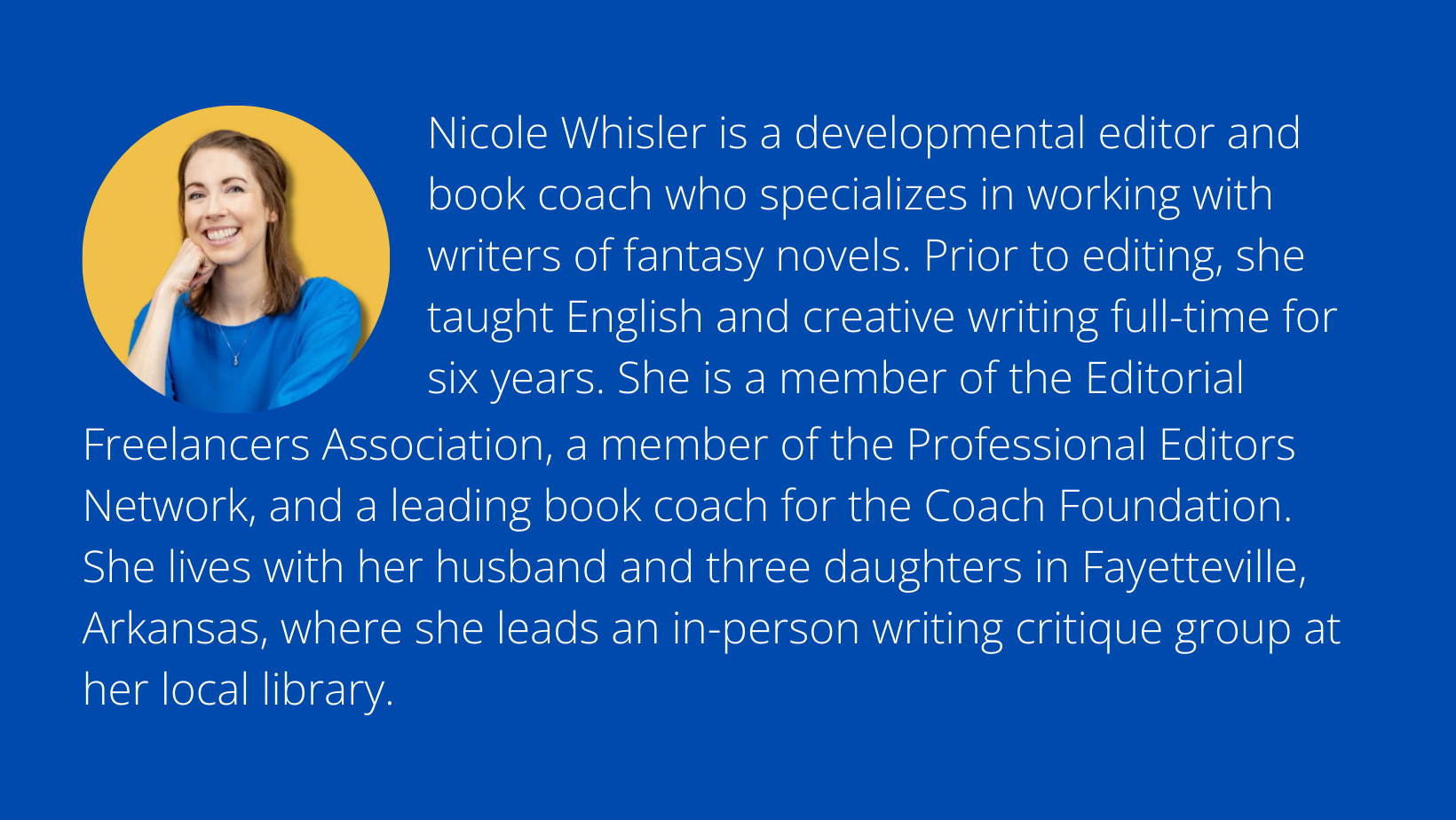
Hi! I'm Nicole.
I’m a Developmental
Editor & Book Coach for Fantasy Writers.
Like you, I'm a writer. I understand the mental and emotional ups and downs of storytelling. Don't let resistance win! Recognize the value of good advice plus hard work.
My approach to novel writing is multifaceted. For a deeper understanding of my process and style, take a look at some of my favorite craft-of-writing books in my Resources section.
What can I say about myself? I read, I write, I read about writing, and I write about reading. It never gets old to me.

See what writers like you are saying . . .

Nadir Shirazi
“I’ve been stalling on my Islam-inspired sci-fantasy series for 10 years. But within 10 minutes of starting Nicole’s program, I started writing again."

Amanda Emerick
“I can’t recommend Fantasy Footsteps enough to writers who are legitimately looking to polish their craft, write, and eventually publish their novel."

Trinity Cunningham
“I loved discussing my story with Nicole. She provided me with invaluable insights I never would have considered on my own."
Latest on the Blog

You will find no pictures of kittens here. No images of favorite dessert recipes, snapshots of my recent vacations, videos of puppies playing the piano (although I do love dogs), or YouTube clips of monkeys stealing people’s sunglasses.
I’m genuinely sorry if that disappoints you.
Instead, you can rely on my blog for clear and specific writing advice, motivational tips, grammatical aid, and author/editor interviews.
As a developmental editor & book coach, everything I post is designed to help you build your creativity, strengthen your prose, and explore new avenues in your writing. The opinions in each post are my own, but many are inspired by ideas from established authors and editors who excel in their fields.
Some of these tips might be just what you need to hear. Others might not work for you personally, and that’s okay.
Apply the tips that fit your personality and writing habits, and feel free to adapt or ignore the others. For further questions and comments, you can email me or reach me through my Contact page.

The Essence of a Story
Discover in this post …
why a character’s "want" is the engine of every successful manuscript.
how to replace boring "and then" sequences with pivotal "therefore" moments.
what The Count of Monte Cristo teaches us about building an unbreakable chain of events.
Words vs. Stories
Have you noticed how much information on craft and prose is available to fiction writers these days?
You could spend the rest of your life watching YouTube videos and masterclasses, listening to podcasts, and reading books and articles about the creative writing process.
Does that stress you out just thinking about it? It can seem daunting to look at the archives and think, Where do I start? (To the rare writer who finds this energizing rather than overwhelming, have at it! Start chipping away at those materials pronto and enjoy the process.)
But to the writer who just wants to know what to focus on and what to ignore as you work toward finishing your draft, you’re in the right place. Today, I’m going to walk you through what matters most if you want to write a powerful story.
So what is it? A character readers can fall in love with? A twist readers won’t see coming? Beautiful language that makes readers pause, hold your book to their chest, and reflect on the wonder and fragility of life?
Sure, those are all great. This post isn’t about neglecting all the ways you can add flavor and heart to your manuscript. It’s about prioritizing the item that matters more than anything else while you’re working on your draft: making sure you’re writing an actual story.
That might sound strange, but if you want to create something that resonates with readers on an emotional level, the words you put on the page need to create something cohesive, something special.
I’m bringing this up because time and time again, I see writers who fall in love with the fictional worlds they create. They adore their characters, their setting, their historical backdrop—you name it.

But rather than write a story, they’ve simply produced a lot of … words. Creative words, certainly. Words that describe things that happen in real time on the page. But unfortunately, in many cases, not a story.
Okay, so if that’s true, how can I tell the difference between a bunch of words and a cohesive story? you might be asking at this point.
Good news! The answer is simple, and I’ve divided it into two items, which you can test for yourself below.
Stage 1 - Who Wants What?
At its core, a story is about a character who wants something and what that character does to get it.
Simple, just like I promised.
So that’s your first test. Name your main point-of-view character(s). Name what they want and what action they take toward getting it. They don’t have to succeed, but they have to pursue a goal of some kind, whether it’s escaping from the labyrinth, getting the girl, winning the race, defeating the villain, solving the mystery, or surviving in the wilderness.
Main POV character: ________________________________
What do they want? ________________________________
What do they do to get what they want? ________________________________
Here’s an example from The Count of Monte Cristo (Warning: Spoilers ahead circa 1846!):
Main POV character: Edmond Dantès, a sailor imprisoned for a crime he didn’t commit
What do they want? To escape from the island fortress and get his life back
What do they do to get what they want? He schemes his way out of prison, swims to safety, sets up a new life for himself, and vows revenge on all his enemies.
PRO TIP: A believable character’s main desire should change as a result of the inciting incident (the big event somewhere around 10% into your story that sets your character on a new path). So feel free to include what your character wants both before the inciting incident (for Edmond, that’s being named captain and marrying the love of his life) and after.
Once you’ve addressed the bullet points above and are satisfied with your answers, you’ve completed Stage 1 of ensuring you’re writing a cohesive story. Let’s move to Stage 2.
Stage 2 - Connecting Your Beats
Once you’ve identified your main character, their goal, and the steps they’re taking to achieve it, you’re ready for the most critical test: determining if you’re writing a mere collection of words or a true story.
You’ve probably heard the way young children tell stories or even describe movies: “Sammy is a superhero who can fly and turn anything to ice … and then there’s a party and he turns the ground to ice … and he has a cape and a supercat … and then the bad guy tries to stop him, and they fight, and Sammy wins!”
Random example, but you get the idea. It’s a list of “and thens.”
This happened. And this happened. Oh, and also, that happened.
It’s boring to listen to a “story” told this way.
Why? Because it’s not a story at all! It’s a list of events. Readers or viewers won’t draw meaning from those events until they can follow a trail of logical consequences that connect those main beats.

The best stories contain a heavy dose of cause and effect. Even absurd comedies need to take this principle seriously. Just ask the creators of South Park, Trey Parker and Matt Stone, who lectured at NYU on this very topic. When we connect our story events, we should eliminate weak connections like “and then” and select causal words like “therefore” and “but.”
Here are some examples that reveal clear causality:
The hero lets slip a secret at a dinner party; therefore, a traitor uses that information against her, leading to her downfall.
The hero tries to woo the love interest by reciting a flowery poem in her honor, but the love interest has no interest in clichés, so her opinion of the hero sinks even lower.
Think of your entire story like links on a chain. If you remove a link, does the story fall apart? It should. Ask yourself, “What happens next because of what came before?”
If causation terms like “therefore,” “because of,” and “but” don’t fit naturally around your story’s major events, look closer at your main character’s choices. Are these decisions actively driving the plot? If not, rework your outline or draft until their actions shape what happens next.
Test It for Yourself
Let’s test this in practical terms. This works for all stages of writing, whether you’re outlining, writing, or revising your draft.
I’ll use the 2002 movie version of The Count of Monte Cristo as our example.
(Warning: Major spoilers ahead! If you haven’t seen the movie, I highly recommend it—it’s one of my favorites.)
STEP 1:
List the story’s major events in chronological order. This is not a detailed list of everything that happens in your story (although you could test that too)—it’s just the overarching main events. For that reason, limit the list to no more than ten items.
Edmond, a kind and intelligent sailor, is arrested on his wedding day and falsely accused of treason.
Edmond is sent to the Château d’If, a brutal island prison.
Edmond meets another imprisoned man, who reveals the existence of a vast hidden treasure on the island of Monte Cristo. The old man dies.
Edmond seizes his chance to take the man’s place in the burial sack. He escapes!
Edmond recovers the treasure the old man told him about. He becomes immensely wealthy and reinvents himself as The Count of Monte Cristo.
Edmond subtly manipulates events to expose and destroy his enemies—the ones who conspired against him years ago and put him in prison. He kills one of his betrayers and ruins others financially or socially.
Edmond must decide whether to continue down that path or choose mercy. He spares some of his enemies, realizing that vengeance has already stolen years of his life. Reunited with his fiancée, he steps into a new future.
STEP 2:

Confirm the causality of the connections between each event. Can you accurately
connect each event using terms like “but,” “because of,” or “therefore”? If so, great! If not, you still have work to do on your story.
I’ve identified the causation of each event in blue.
Edmond, a kind and intelligent sailor, is arrested on his wedding day and falsely accused of treason.
Because he’s accused and pronounced guilty, Edmond is sent to the Château d’If, a brutal island prison.
Consequently, Edmond meets another imprisoned man, who reveals the existence of a vast hidden treasure on the island of Monte Cristo. The old man dies.
As a result of the old man’s death, Edmond seizes his chance to take the man’s place in the burial sack. He escapes!
Because he’s free—and remembers the old man’s words (double causation!), Edmond recovers the treasure. He becomes immensely wealthy and reinvents himself as The Count of Monte Cristo.
Consequently, Edmond subtly manipulates events to expose and destroy his enemies—the ones who conspired against him years ago and put him in prison. He kills one of his betrayers and ruins others financially or socially.
Because he has now tasted revenge, Edmond must decide whether to continue down that path or choose mercy. He spares some of his enemies, realizing that vengeance has already stolen years of his life. Reunited with his fiancée, he steps into a new future.
See the strong causation that links each event? That’s a story that works.
PRO TIP: Story beats contain different levels of causation, from weak to strong. The strongest causations tie directly to your character’s internal arc. External events can move a plot forward, but they rarely deepen it, even if they’re natural consequences of previous beats. But small shifts in character—a lesson learned, a belief challenged, a slightly braver choice than before—create momentum that matters.
Once your own list is solid and you’re ready for the next level—taking those links in your chain and making sure they point to a deeper meaning instead of staying at surface level—you can give my blog post on theme a glance to be sure your character transforms on the page … and in turn, readers transform too.
Did your story pass the test? Did you easily link your main events with terms like “because of” and “but,” or did you find some broken connections that lacked a logical sequence? If this post helped you confirm that you’re on the right track—or if you’re struggling and would love some help applying these concepts to your story—I’d love for you to email me at [email protected] and let me know!
Do you want to learn how to write a story that makes your target readers stand up and cheer? If you’d like support from A to Z (from brainstorming to drafting to revising to publication), book a Discovery Call with me to see if you’re a good fit to join my book coaching program, Fantasy Footsteps: Road to Publication. And if you haven’t done so already, grab your Free Guide on how to hook readers from your story’s start!

Capture Your Readers from Your First Scene
Get my exclusive blueprint—7 Mistakes to Avoid in Your Fantasy Novel’s Opening. Start your fantasy novel right!
Are you worried you've failed to establish a bond between readers and characters in your first chapter? Do you wonder if you've bogged readers down with your worldbuilding? Do you sometimes overlook essential conflicts? Many readers will put your book down if it doesn't grab their attention right away, so it's vital to evoke powerful emotions from readers as early as possible.
Don't let these common mistakes rob your story of its magic and momentum. Save your precious time and energy by ensuring you hook readers from the start. Grab your guide now and check your opening against these common missteps!
(You will also receive monthly writing advice, updates about my free live trainings, and direct access to replays. Unsubscribe anytime.)