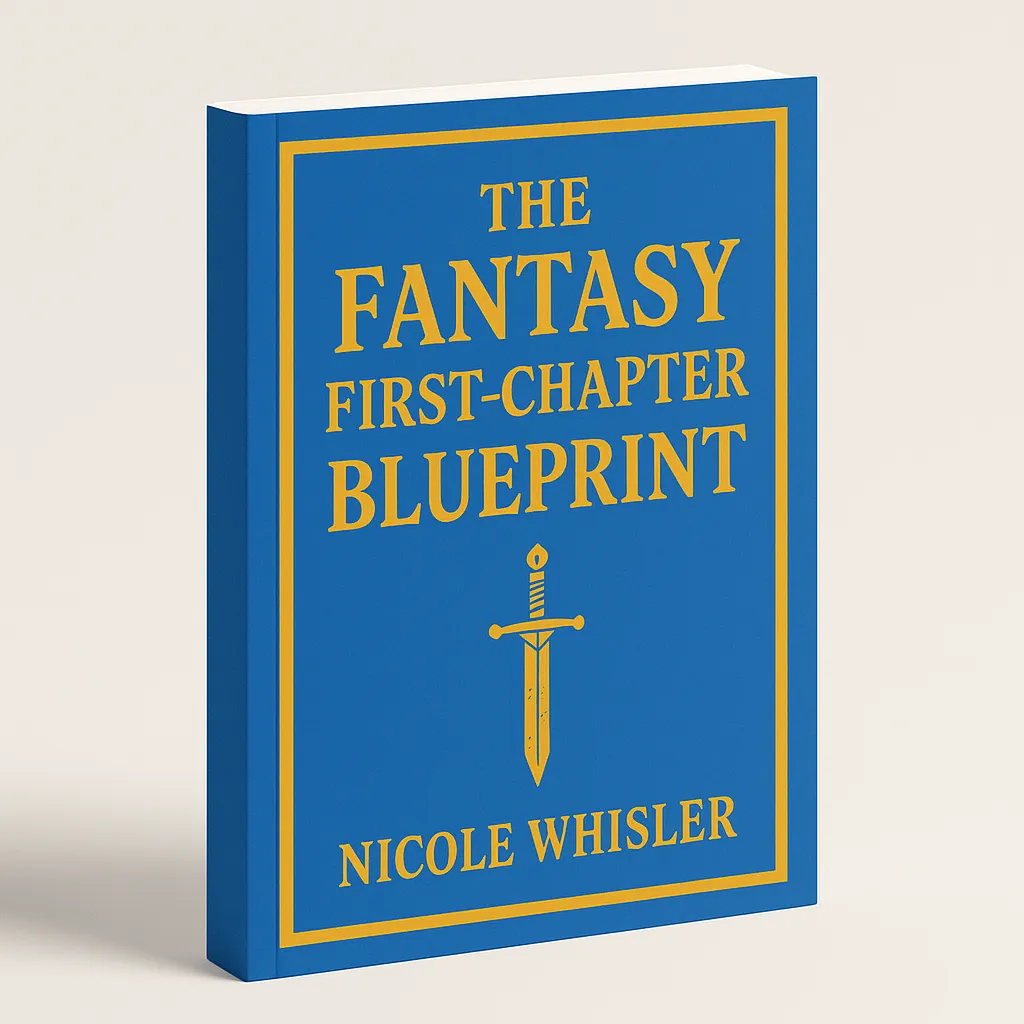
The Fantasy First-Chapter Blueprint
Your first chapter is your one shot to hook an agent or a reader. Don't let the 7 deadliest mistakes land your manuscript in the rejection pile. This free 7-day email course gives you the step-by-step blueprint to avoid them and craft an irresistible opening.

Your Novel Matters ...
Looking for the right book coach for your fantasy novel?
Are you a fantasy writer …
… struggling to convert the vivid scenes of your fantasy novel from your imagination to the page?
… stuck in a loop where you constantly rewrite your opening pages?
… worried your story won’t resonate with your readers?
What if I could show you the exact steps week to week that would take you from brainstorming and drafting to revising and publication?
I specialize in developmental editing and book coaching for writers of fantasy novels—writers who value the craft of storytelling and wish to create stories that resonate.
My Services
Develop Your Ideas
Fantasy Footsteps: Road to Publication
I’ll let you in on a secret. All you need to succeed as a writer are three things:
A Roadmap: Illuminate your path with a step-by-step guide, ensuring you achieve your writing goals every week. From outlining to publishing, every stage of your journey is mapped out for success.
Mindset Mastery: Learn how your thoughts control your outcomes in your writing. Overcome self-doubt and unearth the confidence that will bring your unique ideas to life on the page.
Personalized Support: Prepare for comprehensive assistance, real-time accountability, and feedback tailored to your needs. From brainstorming sessions to final publication, you'll have a dedicated ally guiding you every step of the way.
With these three pillars, you'll unlock the potential to:
Craft a captivating story that enthralls readers from the first page to the last.
Develop complex characters and immersive worlds that resonate deeply with your audience.
Navigate the complexities of plot twists and pacing, keeping readers hooked until the final chapter.
Receive specific guidance on refining your scenes so that readers root for your protagonist.
Overcome writer's block and stay motivated throughout your writing journey, ensuring consistent progress.
Transform your rough draft into a polished, professional manuscript ready for publication.
Are you ready to turn your fantasy novel from a mere vision into a masterpiece that captures hearts and minds?
Join Fantasy Footsteps: Road to Publication and begin your author journey with everything you need to write a story that works.
Don't let your story remain trapped in your mind—bring it to life with me!
If you’re thinking, “Yes, please! Tell me what to do!” , I’d like to invite you to work one-to-one with me to finish your novel and write a story that works. Join my book coaching program designed specifically for fantasy writers—Fantasy Footsteps: Road to Publication.

Discover Helpful Tools
Resources For Writers
Here you will find some of my favorite resources for writers.
Add these books, podcasts, websites, and other resources to your writing toolbox to augment your writing at any stage.
Join My Free, Private Facebook Group
Finish My Fantasy Novel: Write & Revise My Best Book in 6 Months
In the group, I go live weekly with writing tips. The group is also a platform for writers to support each other and share their wins and progress.
Live training schedule:
1st Tuesday of the month: Free critique for someone in the group!
2nd Tuesday of the month: Writing sprint with fellow writers
3rd Tuesday of the month: Live training on a specific topic
4th Tuesday of the month: Interview with an author or marketing/business expert


Improve Your Craft
Writing Advice Blog
As a developmental editor and book coach, everything I post is designed to help you build your creativity, strengthen your prose, and explore new avenues in your writing. The opinions in each post are my own, but many are inspired by ideas from established authors and editors who excel in their fields.
Rely on my blog for clear and specific writing advice, motivational tips and grammatical aid, and interviews with experts!
Hi! I'm Nicole.
I’m a Developmental
Editor & Book Coach for Fantasy Writers.
Like you, I'm a writer. I understand the mental and emotional ups and downs of storytelling. Don't let resistance win! Recognize the value of good advice plus hard work.
My approach to novel writing is multifaceted. For a deeper understanding of my process and style, take a look at some of my favorite craft-of-writing books in my Resources section.
What can I say about myself? I read, I write, I read about writing, and I write about reading. It never gets old to me.

See what writers like you are saying . . .

Nadir Shirazi
“I’ve been stalling on my Islam-inspired sci-fantasy series for 10 years. But within 10 minutes of starting Nicole’s program, I started writing again."

Amanda Emerick
“I can’t recommend Fantasy Footsteps enough to writers who are legitimately looking to polish their craft, write, and eventually publish their novel."

Trinity Cunningham
“I loved discussing my story with Nicole. She provided me with invaluable insights I never would have considered on my own."
Latest on the Blog

You will find no pictures of kittens here. No images of favorite dessert recipes, snapshots of my recent vacations, videos of puppies playing the piano (although I do love dogs), or YouTube clips of monkeys stealing people’s sunglasses.
I’m genuinely sorry if that disappoints you.
Instead, you can rely on my blog for clear and specific writing advice, motivational tips, grammatical aid, and author/editor interviews.
As a developmental editor & book coach, everything I post is designed to help you build your creativity, strengthen your prose, and explore new avenues in your writing. The opinions in each post are my own, but many are inspired by ideas from established authors and editors who excel in their fields.
Some of these tips might be just what you need to hear. Others might not work for you personally, and that’s okay.
Apply the tips that fit your personality and writing habits, and feel free to adapt or ignore the others. For further questions and comments, you can email me or reach me through my Contact page.

Pulling Yourself Out of a Writing Slump
Discover in this post …
how to set realistic expectations and give yourself grace during a slump.
ways to remind yourself that slumps are temporary and that reconnecting with your “why” is possible.
how to move forward with a simple, actionable step you can take today.
New Year, New You?
If you’re anything like me, you look forward to the new year. There’s something about shaking off the past and embracing new goals and a new version of myself that I’ve always found appealing.
And yet, this year, 2026 arrived … and I spent the first two weeks sick.
I went from having a blast with family at Christmas and New Year’s to coughing my head off, nursing a raw, aching throat, and wondering whether playing all that Taco Cat Goat Cheese Pizza (a hand-slapping card game) was really the best idea ... because nearly everyone else in my family ended up catching the bug too.

In 2025, getting up around 6 a.m. was “sleeping in” for me—and in 2026, I found myself sleeping until nearly 10 a.m. several days in a row, something I haven’t done in years.
My body needed rest. My body wanted to recover. And to be honest, I was angry at my body for feeling that way.
Sometimes, something as simple as getting sick can push you wildly off track from where you want to be in your daily habits and your writing. You lose an hour, then a day, then a week, and you wonder how you’re suddenly so far removed from everything you planned to achieve.
Has this ever happened to you? If you’re like me, sometimes you’re easily able to regain your momentum, but other times it feels impossible. On the worst days, you might even question your purpose as a writer—Is this what I’m supposed to be doing? Am I following the right path?
Whether it stems from sickness for you or from something else, finding yourself in a writing slump can be tough on your identity and can severely slow your writing progress. Let’s explore a few ways we can survive the slump, understand it more clearly, and eventually break ourselves out of it.
Set Your Expectations According to Your Personality
First, you’ll notice that one of my problems above centered around my expectations (hello, new and improved 2026 version of myself!) clashing with my reality (hello, laryngitis and exhaustion).
It’s the same for writing. When you’re all set to embrace a new writing identity—the professional version of you who declaims the amateur and writes every day, pooh-poohs excuses, and moves fluidly from one chapter to the next—but you lose all momentum shortly after committing to this new identity … well, that’s tough for your inner self to reconcile.
Am I a total failure? My goal flopped within two minutes of setting it.
That’s why whenever possible, I like to set expectations that align with my personality.
Over the years, I’ve set writing expectations (and encouraged my clients to set them) in two separate ways. Either method can prove effective—you’ll just need to do some trial and error to see which works best for you at any given time.
Expectation Type #1: “Shoot for the moon, and even if I miss, I’ll land among the stars.”

This method of goal-setting works incredibly well for the type of writer who likes to visualize their success on a big-picture level—someone who’s fairly laid-back and willing to celebrate every step forward as a win.
If this is you, you might set the expectation that you’re going to finish the first draft of your novel this year. Next year, you'll revise it, publish it, and get it into the hands of eager readers. You love picturing yourself talking to your biggest fans, explaining what you went through to get your story into print.
Then, whether you achieve your goal or not over the next two years, you’re proud of yourself for taking action. You’re aware that you succeeded either way because you accomplished so much more than you would have if you hadn’t set the goal.
I’ve seen this method lead to incredible results, all because the writer was willing to expect big things and take steps in the right direction.
Not all writers think this way, though. There’s a second method I’ve used for setting expectations:
Expectation Type #2: “Set small goals I know I can accomplish. Extend those goals over time.”

For writers who don’t respond well to the first expectation type (because they tend to view themselves as failures when they don’t do exactly what they set out to do), I recommend this second option. Expectation Type #2 is for perfectionists, for writers who want to view themselves as successful on a daily and weekly basis, writers who tend to feel uneasy about big-picture goals rather than embrace them.
If committing to finishing your book within the next few months sends you into an anxious spiral, but the idea of writing for fifteen minutes a few times a week sounds doable, you’ll know this is you.
By setting small, achievable goals, you’ll learn to build trust in yourself. Start with something you know you can do (like writing for fifteen minutes at least three days a week). Do that until you build your frequency in that area, then shoot for consistency.
One of my clients is very successfully writing for fifteen minutes a day five days a week, and she’s been amazed how many words she can write in that limited time frame (500 each time). Now that she knows this is working well for her, she’s extending that time frame to fifteen minutes twice a day, five days a week.
Another of my clients writes in a single twenty-five-minute time block. But when her timer goes off, she's usually back in the creative zone by that point and chooses to keep writing. Getting started is the hardest part for her, so the goal is simply to get her brain to begin and let momentum take over.
Ideally before a slump overcomes you, but during the slump if it has already hit, choose the expectation type that best fits your personality and set your goals and expectations around that. (In the long run, setting both big-picture goals and small daily or weekly goals can be highly effective, but if you’re currently in a writing slump, just pick your personality type and focus on one main goal for yourself—whether it's finishing your draft by the end of the year or spending just a few minutes with your characters and story per day.)
Give Yourself Grace
When we’re going through an off season, it’s essential to give ourselves grace rather than assume an identity of failure.
In my case, before getting sick, I had set a strict schedule for myself to exercise five days a week from 5:30 to 6 a.m. I’ve successfully done this for years. But when I got sick on January 1, my body needed rest. By the time I woke up, it was no longer dark outside, and I had the odd feeling of being late to my own life.
When this happened, two paths loomed before me:
Path A - Beat myself up for breaking a habit I was proud of forming. Tell myself that I had failed and might as well give them up entirely. (See that all-or-nothing mentality? It still tries to sneak in now and then.)
Path B - Give myself grace. Celebrate how long I had maintained the routine. Tell myself that I’ll start exercising again soon, and that small steps still count.
Most of us would choose Path B—it’s just easier said than done. That doesn’t make it impossible; it simply requires awareness and intention. And if self-talk like this feels difficult or unproductive, reach out to me. That’s exactly the kind of work I help writers with every day.
Don't Forget It's Temporary
On a similar note, do you ever get the feeling that your writing slump will last forever? Even if your rational brain knows that isn’t true, it can be hard—especially in the middle of a slump—to separate reality from fiction. When you’re feeling low, it’s difficult to imagine feeling any other way. It starts to feel like your new normal, and your mind may whisper, This is me now. This is just how things are.
When that happens, remind yourself: This isn’t forever. This is a blip on the radar. I won’t always feel the way I do right now, and it may pass sooner than I expect.
This simple reframing helps me shift my focus away from my current frustration and toward the knowledge that change is coming. It doesn’t fix everything, but it creates enough space to breathe. Sometimes, that’s all you need to move forward again.
Revisit Your "Why"
Another reason a writing slump can feel so insufferable is that, for many of us, writing is tied closely to our identity. When we feel unable to write, we have the sense we’ve lost our footing entirely, and it’s easy to spiral from there.
Early in the writing and brainstorming process, I ask my clients to identify and journal about their deepest reasons for wanting to tell their stories. Why do they need to finish this manuscript? Why is it not just important, but nonnegotiable, to write “The End” and share their story with the world?
Once those reasons are written down, they become tangible evidence of why the work matters. When motivation dips, writers can return to those pages—to the earlier version of themselves who felt lit up by the project—and reconnect with what originally drove them to begin.
More often than not, that energy carries them forward, and writing becomes possible again.
Pick One Thing
Last—and here’s one of the first big steps out of the slump itself—in order to start digging ourselves out of the slump, we have to understand its root cause. Ask yourself, “Why am I feeling the way I’m feeling?”
There are a surprising number of items that could have caused the slump. Maybe you’re having trouble with a character or plot point, or your mind goes blank anytime you try to move forward on the page, or you’re physically sick like I was, but these are all surface-level reasons. They don’t explain the deeper cause of the slump.
For example, if you’re having trouble with a character or plot point, what’s keeping you from simply figuring out that character’s motivation or coming up with a new story idea that resolves the issue? This has probably happened before, and you were able to move past it.
Maybe the actual issue is that you suddenly worry your story isn’t good enough, and that no one will want to read it other than yourself. That’s an example of a deeper reason.
Or if you take my example of being sick, what was stopping me from giving myself a few days’ grace and picking up where I left off once I felt better?
For me, the actual problem was one of overwhelm—I had a to-do list I wanted to complete by a certain timeline in my head, and getting sick moved me backward on that timeline instead of forward, producing extra stress. The true issue, then, was that my thought became: I’m behind.

Once you’ve identified the true culprit that’s causing the slump, ask yourself, “What’s one thing I can do today to get closer to getting back on track?”
It doesn’t have to be something big. Maybe you journal about a character or jot down a few story notes you’ve been holding in your head.
Doing something, anything at all, signals to your brain that you’re getting back on track and that nothing terrible has happened. You don’t need to return to your full writing routine all at once. Start small, and before you know it, you’ll be climbing back up, one step closer to finishing your draft.
Have you experienced a writing slump recently? Or are you in one now? You’re not alone. Every writer I’ve ever met has gone through a low point related to their story ideas or motivation. The key solutions are to set expectations that match your personality, give yourself grace, remind yourself it’s temporary, revisit your “why,” and choose one simple action that will move you toward getting back on track. And remember: you don’t have to do this alone. If you’re ever looking for extra support and direction in your writing goals, this is exactly what I do. You know where to find me—email me anytime at [email protected] and ask for support!
Do you want to learn how to write a story that makes your target readers stand up and cheer? If you’d like support from A to Z (from brainstorming to drafting to revising to publication), book a Discovery Call with me to see if you’re a good fit to join my book coaching program, Fantasy Footsteps: Road to Publication. And if you haven’t done so already, grab your Free Guide on how to hook readers from your story’s start!
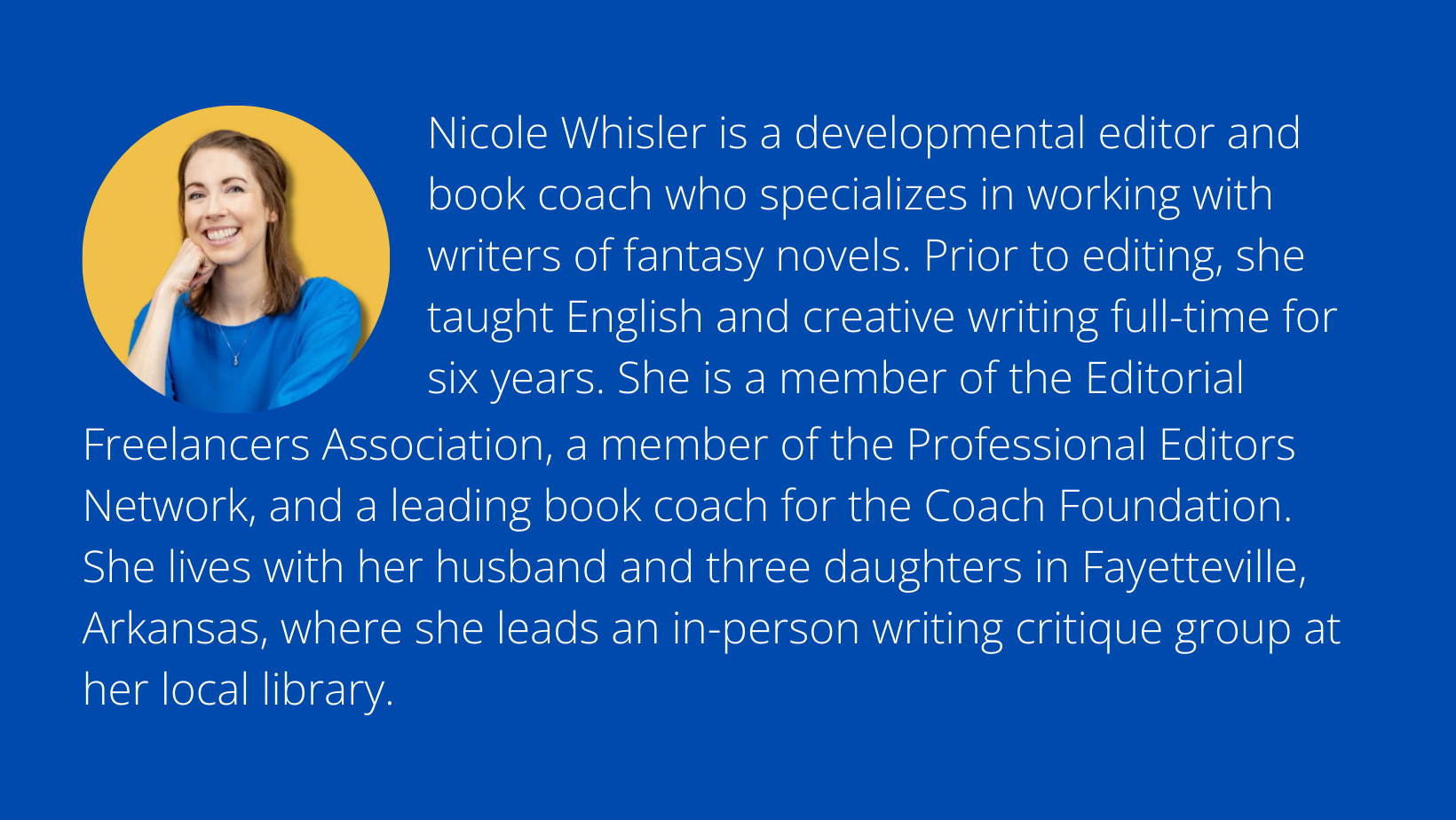

Capture Your Readers from Your First Scene
Get my exclusive blueprint—7 Mistakes to Avoid in Your Fantasy Novel’s Opening. Start your fantasy novel right!
Are you worried you've failed to establish a bond between readers and characters in your first chapter? Do you wonder if you've bogged readers down with your worldbuilding? Do you sometimes overlook essential conflicts? Many readers will put your book down if it doesn't grab their attention right away, so it's vital to evoke powerful emotions from readers as early as possible.
Don't let these common mistakes rob your story of its magic and momentum. Save your precious time and energy by ensuring you hook readers from the start. Grab your guide now and check your opening against these common missteps!
(You will also receive monthly writing advice, updates about my free live trainings, and direct access to replays. Unsubscribe anytime.)