
Morning Formula for Writers: Start Your Day Strong
Discover in this post …
a simple morning audit to identify the tone you’re currently setting for your day.
a psychological trick to beat the snooze button and get your feet on the floor.
a streamlined system to clear mental clutter, foster gratitude, and set daily goals.
Night Owl to Early Bird
Ten years ago, before I had kids, I was a night person. My husband and I taught full time, and we would stay up until 3 a.m. in the summers watching Netflix, reading, and (in my case) writing.
Even before that, I was never a morning person. In fact—just so you can get the full effect of my transformation—I remember waking one Saturday when I was nineteen or so, showering, and venturing downstairs. The clock showed 12:15 p.m., and I distinctly recall thinking to myself (without any sarcasm), Nice work. I’m already up and clean and ready for the day.
Fast forward nearly two decades, and I now get up at 5:30 a.m. five days a week.
What made the difference? Kids, partly, but more than that, I changed my habit by making my early rising nonnegotiable.
And let me tell you, that didn’t happen through sheer willpower. It happened because back in 2016, I accepted an online job teaching English to students in China. Seven days a week for four years, I got up at 4:25 a.m. so that I could work while the rest of my family was sleeping. If I had overslept and missed classes, I would have been fired.
And now, even though I don’t teach those classes anymore, the habit of waking early has stayed with me. The opportunity to be productive in the morning is too tempting to pass up.
This post is for writers who want to start their day strong, writers who want to be focused and intentional about their goals. I’m going to share a strategy that has helped me do exactly that.

As the character Hopper in Stranger Things famously says, “Mornings are for coffee and contemplation.” Let's add to that idea. After all, what kind of contemplation prompts a productive day?
The strategy below is designed to help you show up each day as your best self. Although the items work well when used together, feel free to adjust the formula as needed so that it fits seamlessly into your own routine.
Morning Formula 101
In a single word, what describes your morning? Chaotic? Rushed? Peaceful?
Your morning has so much power over you. When you start off on a low note, that negative tone can easily carry over to the rest of your day. When you begin with intentionality, on the other hand, you’re able to accomplish more and feel more grounded.
What do you do first thing in the morning? Check your phone? Your email?

Read a news story that angers you and puts a damper on your day? This seemingly small moment can cause ripple effects we don’t always see right away. If we want to ensure those ripples produce something positive, we need to set ourselves up for success.
Here’s the exact morning formula I recommend. If you’re anything like me, you thrive on goals, expectations, and systems, so you might be pretty excited to read on and see if there are any gold nuggets here you can apply. Whatever the case, take what’s useful to you and give yourself the flexibility to adjust the following as needed.
Morning Formula
Set your alarm for thirty minutes earlier in the morning. Most of us can do this—we just don’t want to. (For those of you groaning at this one already, fifteen minutes earlier might work just as well. You’ll want to test it out to see.)
Use Mel Robbins’s five-second rule, which says this: The second you have an instinct to act on a goal, if you don’t act on that goal within five seconds, your brain will kill that instinct, and you won’t do the thing you initially wanted to do. Here’s how to relate that to your morning:
a. Once your alarm goes off, count backward from five and instead of hitting snooze, get up. Just act. Five … four … three … two … one … Boom! Put your feet on the floor.
b. Get out of your room as soon as possible. That way, you won’t be tempted to go back to bed.
NOTE: I challenge you to try the five-second rule and see if it resonates with you. At first, I was skeptical that my brain would even remember this rule in the morning. But when I tried it for myself, it worked!
Follow your regular hygiene routine (shower, hair, makeup, etc.).
Drink a glass of water to hydrate you.
Get out your planner or journal (the picture you see below shows my actual daily planner with a quick example) and jot down three items (three Gs):
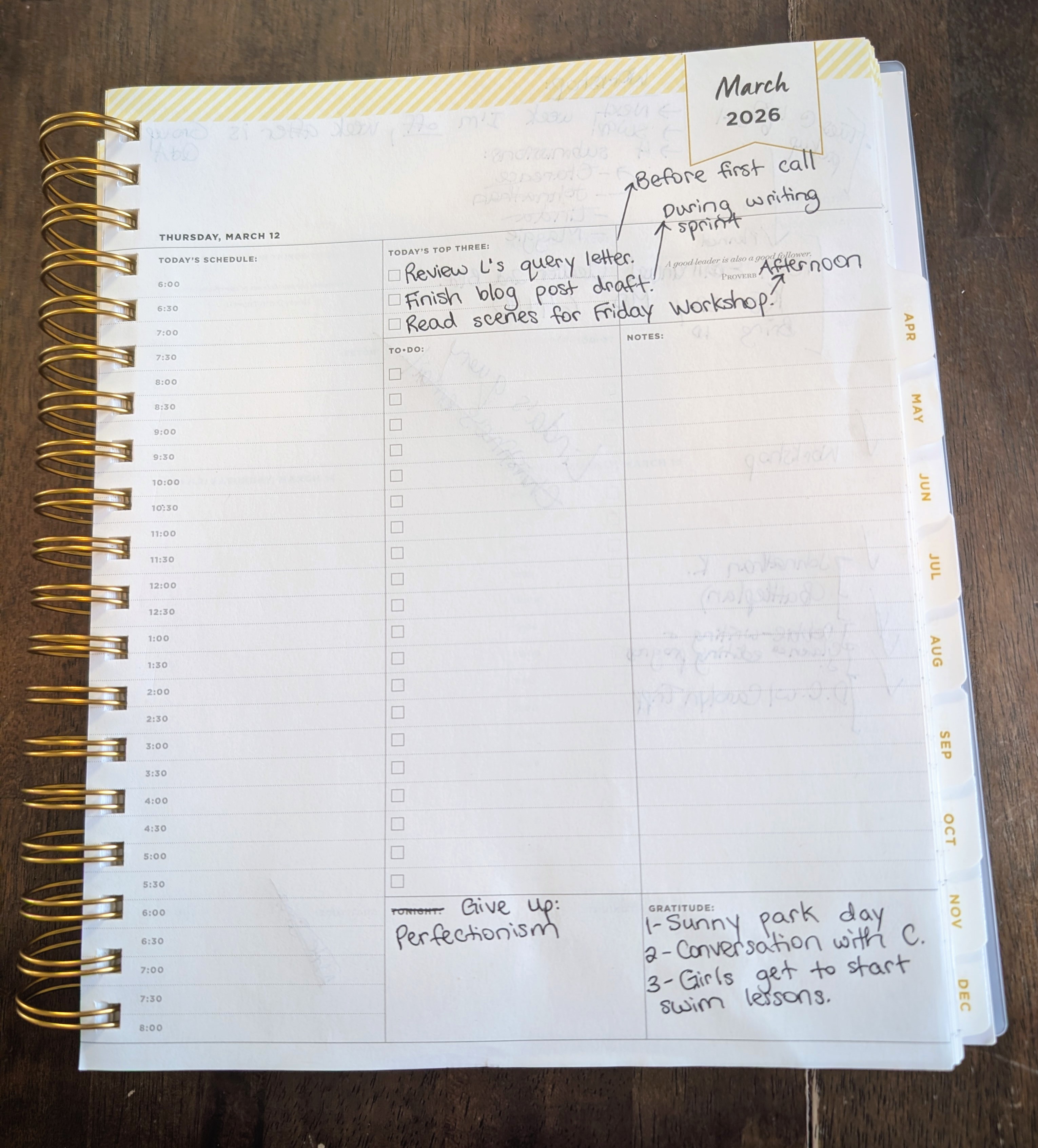
a. GRATITUDE - With all the negative news stories and complainers in the world, gratitude doesn’t always come naturally. It’s our job to train our brains to focus on the items that will make us our best version of ourselves, not the items that will drag us down. Write down three things you’re grateful for today. Get deep with it. Don’t just write “family, food, and friends.” Maybe your son or daughter said something hilarious the day before. Maybe you went out on a date night with your partner and don’t get to do that very often. Record those moments on paper!
b. GIVE UP - Choose one thing to give up for the day that’s not serving you. Maybe you've recently been binge-watching shows on Netflix, and you want to give up TV for a day and read more instead. Or maybe you’re in a critique group and you received harsh criticism about your writing the previous day. You feel crushed by those words, but you already took time to process them yesterday. Today, you choose to give up the temptation to dwell on them.
c. GOALS - Write three goals for the day. When your to-do list has twenty items on it, it can easily overwhelm you. But if you write just three concrete things that need to be done that day, you’ll stay more focused. (Don’t write down three things that you hope to do. Write three things that really need to be done by the end of the day. What’s in your power to accomplish?) As a writer, one of your three goals could be a specific word count or finishing a scene, but make sure it’s one of the three—don’t bury your writing under a mountain of other chores!
Pro Tip: Draw three lines coming out of your Goals section and write down exactly how you’re going to accomplish those items. What actions do you need to take to ensure you complete your goals? When will you do them and how? When we don’t plan ahead, it’s easy for time to speed by during the day and leave us wondering why we never accomplished our list by the day’s end.
Last, quiet your mind. This might be meditating, praying, or taking a few quiet moments in stillness. In whatever way works for you, return your attention to what you wrote down—especially your gratitudes. Give yourself a few minutes to sit with your list and set your tone for the day.
This morning formula will strengthen your mental fortitude and help you step into the day with clarity and focus. By anchoring your mindset early, you’re ensuring the day’s chaos doesn’t dictate your creative energy. If you’ve never tried something like this before, give it a shot!
Handling Obstacles Ahead of Time
As amazing as it would be to integrate this routine seamlessly into our schedules from day one (and to follow through with accomplishing our three goals), we all experience setbacks at times. We have days or weeks when we’re sick, or our kids are sick, or our car breaks down. Days when it’s harder to get out of bed, or when something throws off our plans later that day.

I recommend two main ways to increase the chances that you’ll succeed in your new routine:
Make sure the three goals you write down are all possible for you—that you see a clear course of action you can take to achieve them. This sounds obvious, but as I mentioned above, sometimes we’re tempted to write down what we hope to achieve instead of what we actually need to accomplish. That’s a mistake that tends to backfire (because our mind secretly knows what needs to be done, but if we haven’t put those items front and center, we might forget about them and not accomplish much at all).
Have a Plan B. What are you going to do if circumstances throw off your expected routine? You don’t need to get overly detailed here, but have some ideas in mind. Take a moment to visualize your Plan B right after you jot down your goals or during those final quiet moments of meditation. When we’re thinking only about Plan A, we tend to get frustrated when things don’t go our way. But when we expect the unexpected, we can stay in motion and, more often than not, accomplish our goals in spite of the obstacles in our path.
You don't have to be a “perfect” morning person to make this work. The goal is simply to give yourself the best possible start. Some days will be smoother than others, but having this system in place ensures you aren't reacting to the chaos of the day as it happens. Instead of being a character in someone else’s story, you’re the one holding the pen. Test it out tomorrow and see how it shifts your perspective.
Do you already have a morning routine? If not, how do you see the habits above fitting into your schedule? What steps would you like to add to your current system that will help you? Email me at [email protected] and let me know!
Do you want to learn how to write a story that makes your target readers stand up and cheer? If you’d like support from A to Z (from brainstorming to drafting to revising to publication), book a Discovery Call with me to see if you’re a good fit to join my book coaching program, Fantasy Footsteps: Road to Publication. And if you haven’t done so already, grab your Free Guide on how to hook readers from your story’s start!